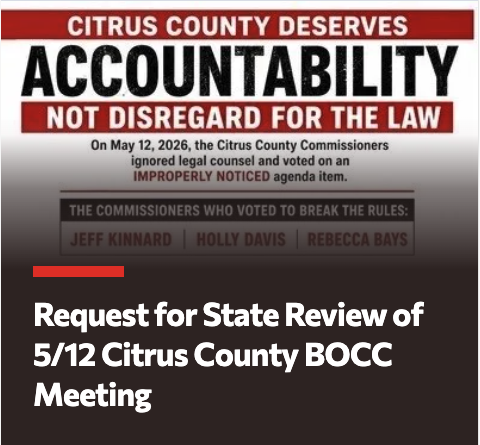
News Alerts! & Headlines in the Media
Our Latetest Activities in the Media
Citrus County Residents Organize Against Hyperscale Data Centers as Opposition Movement Surges
More than 6,000 persons have supported No Data Center Citrus efforts as residents mobilize ahead of a major May 23 public forum — part of a national wave of bipartisan opposition that has blocked or delayed an estimated $98 billion in data center projects.
CITRUS COUNTY, FL — A rapidly growing grassroots movement is gaining momentum across Florida’s Nature Coast, where residents of Citrus County are organizing against proposed industrial rezoning and hyperscale data center development tied to artificial intelligence expansion. The organization No Data Center Citrus (NDC) reports more than 6,000 people have supported its efforts — making it one of the fastest-growing citizen-led land-use campaigns currently active in the state.
What began as a local response to zoning discussions has evolved into a broader regional movement, and organizers say the issue has struck a nerve among residents who fear Citrus County could become the next front in the national race to build energy-intensive digital infrastructure.
“People here choose Citrus County because of its rural character, springs, waterways, wildlife, and slower pace of life,” “They don’t want to wake up one day and find themselves living next to an industrial AI corridor.” said Athalene Bulla of Hernando who lives close to the proposed site.
What Residents Are Concerned About
Organizers cite a wide range of documented local impacts, backed by independent research and state legislative findings:
- Electrical demand of up to 300 megawatts — equivalent to the entire peak residential load of a small Florida county — with no defined cap
- Water consumption of potentially millions of gallons per day drawn from the Floridan Aquifer, with no proposed withdrawal limits or aquifer impact study required
- 24/7 industrial noise, including low-frequency noise that can can travel several miles, penetrates structures and is associated with sleep disruption and chronic stress.
- Permanent land use change across 800+ acres, with heavy industrial zoning that is rarely reversed once approved
- Human and wildlife health impacts from diesel generator emissions, chemical cooling agents, and habitat destruction
- Electronic waste and decommissioning risk, as data center facilities have 10–15 year operational lifespans with no financial bond or cleanup plan currently required
- Minimal permanent employment — Google’s 500-acre campus in Kansas City is projected to create just 200 permanent jobs. A Virginia state legislative study found a typical large data center employs approximately 50 full-time workers, about half of them contract positions. A Brookings Institution study confirmed that data centers “often promise only dozens to a few hundred permanent workers” while construction jobs are temporary — and that tax subsidies can cost communities over $2 million per permanent job created.
Supporters of hyperscale development often cite economic development, tax revenue, and technology investment. But residents argue the long-term costs to communities outweigh the benefits — particularly in rural areas that would bear the full burden of industrial impacts without proportionate economic return.
May 23 Public Forum Expected to Draw Statewide Attention
Momentum surrounding the movement is expected to intensify at the upcoming “Unite Citrus Public Forum” on Saturday, May 23, 2026, from 4:00 to 6:00 PM at The Old Schoolhouse, 2415 N Florida Ave, Hernando, FL. The free public event will feature speakers addressing industrial rezoning, environmental concerns, infrastructure impacts, electricity and water usage, noise and light pollution, and ways to take action.
Confirmed speakers include Florida gubernatorial candidate Bobby Williams (bwflgov.com) and Florida Chief Financial Officer candidate Dr. Frank W. Collige (frankforchange.com), reflecting the growing statewide political significance of data center expansion and land-use debates.
The event is non-partisan, free and open to all residents, environmental advocates, community leaders, and concerned citizens.
A National Wave of Bipartisan Opposition
Citrus County is far from alone. According to a report by Data Center Watch — a research firm whose clients include AI companies and major U.S. tech firms — more than 188 opposition groups are now actively organizing against large-scale data center projects nationwide, and an estimated $98 billion in projects were blocked or delayed in the second quarter of 2025 alone. The report found that resistance is bipartisan: Republican officials frequently cite concerns over tax incentives and grid strain, while Democrats focus on environmental and resource impacts.
In Utah, residents recently protested a proposed 60-square-mile AI data center project backed by businessman Kevin O’Leary, voicing concerns about water usage, emissions, and infrastructure strain. In Michigan, multiple towns enacted moratoriums following backlash over a massive AI data center tied to the Stargate initiative. And in Florida, a proposed data center project in Okeechobee County was recently scrapped amid growing public opposition.
Organizers in Citrus County also point to growing statewide coordination through initiatives like Florida Data Centers, which tracks proposed projects, zoning concerns, and community impacts across the state.
“There’s a growing awareness that this isn’t just about one project,” said Jason King, a Citrus County resident and volunteer with No Data Center Citrus. “Communities across the country are beginning to ask hard questions about who benefits, who pays the cost, and what kind of future these developments create.” he said.
Local Organizing Continues to Grow
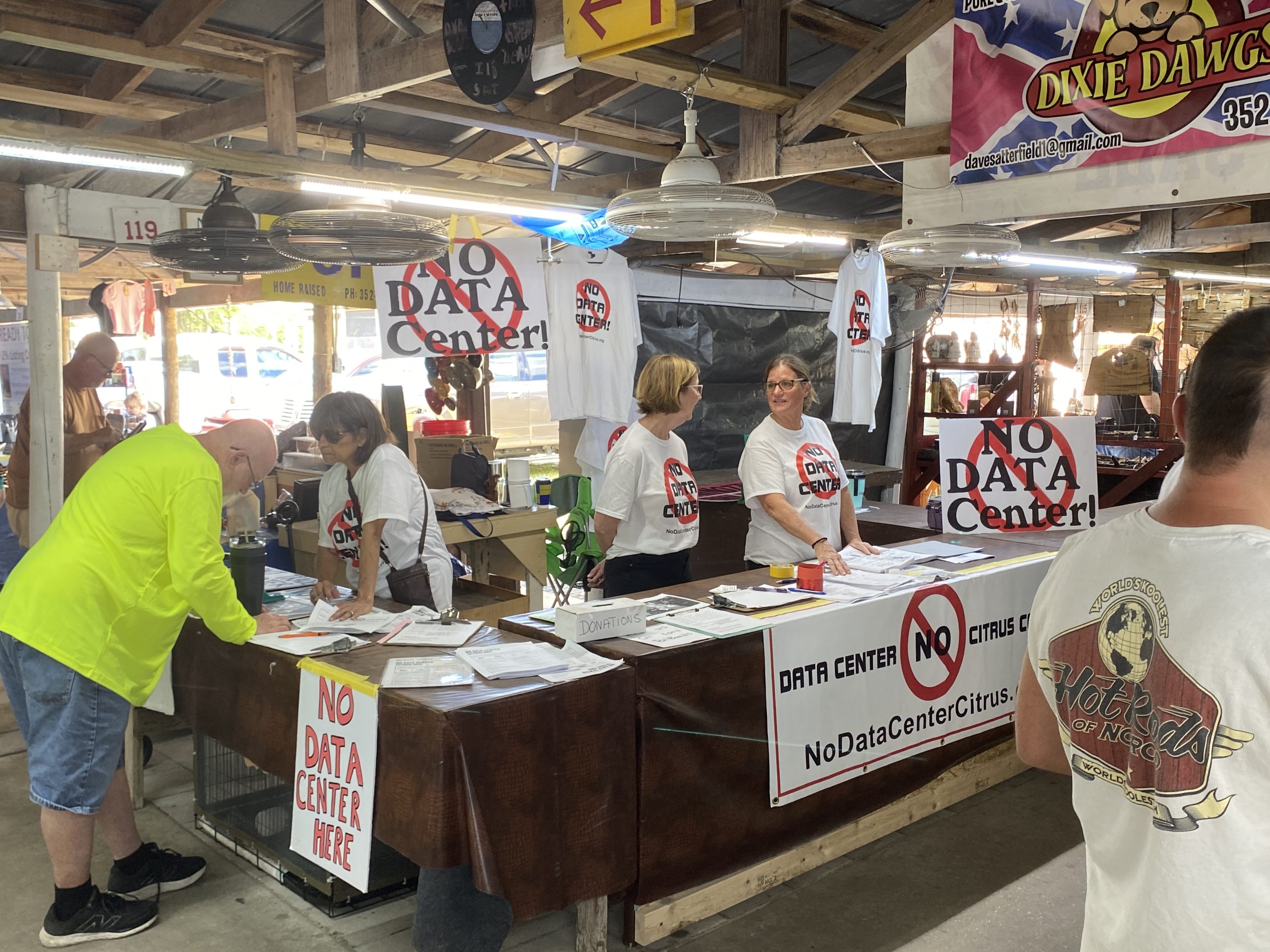
No Data Center Citrus volunteers have built the movement through online petitions, street rallies, educational outreach, and community engagement at Howard’s Flea Market and other venues throughout the county. At public meetings, organizers say attendance has steadily increased as residents seek more transparency regarding zoning discussions and long-term planning decisions.
“We are seeing people from all walks of life getting involved because they understand what is at stake,” said Del W, a Citrus County resident. “This is about protecting our water, our land, and the future of rural Citrus County.”
As Florida positions itself as a potential hub for hyperscale development, the resistance in Citrus County appears to be growing rather than slowing — and organizers say they are only getting started.
“This is about making sure Citrus County has a future that reflects the people who live here,” organizers said. “Once this land is changed, it cannot be easily undone.”
EVENT DETAILS
Unite Citrus Public Forum – Saturday, May 23, 2026 | 4:00 – 6:00 PM
The Old Schoolhouse | 2415 N Florida Ave, Hernando, FL
Free and open to the public | RSVP & Info
Sources & References
Florida Data Centers Coalition
Data Center Watch — Opposition Report
Brookings Institution — Data Center Employment Effects
WUSF Public Media — Florida Data Center Proposals
arXiv — Hyperscale Data Center Constraints Research
New York Post — Utah Data Center Opposition
Tom’s Hardware — Michigan AI Data Center Moratoriums
WLRN — Okeechobee County Data Center Opposition
__________________________________________________
Media Contact
No Data Center Citrus | nodatacentercitrus.org
Email: info@nodatacentercitrus.org | Phone: 352-593-8934
__________________________________________________
Related News
Citrus County residents, commissioners in battle over potential data center in Holder
A developer is urging Citrus County commissioners to more than double their rights over land in Holder to build an industrial park.
Wooten seeks legal action against Finegan
By MICHAEL D. BATES
Updated May 15, 2026
Citrus County residents, commissioners in battle over potential data center in Holder
By Evan Axelbank
Published March 9, 2026 5:04pm EDT